Sales Forecasting for FMCG – Demand Sensing
Problem Statement
“Not efficinet demand forecast accuracy and forecast bias for FMCG production company”
Assesment
Global plant-based food producer contacted us. Creating forecasts was a challenging process for demand planners. Often, it ended up not being accurate enough to be useful, but producing it was still very time-consuming.
Our cooperation began with the customer outlining their requirements, such as:
- Desired forecast period,
- Prediction granularity (e.g., product level or grouped units)
- Details about their current forecasting approach
Data Audit
Next, the access to data sources was provided, together with insights into demand-related factors, such as:
- Product specifications
- Seasonality
- Trends
- Product lifecycle information (e.g., frequency of new product introductions or retirements)
This input was crucial for shaping the project and ensuring alignment with business needs.
Integration
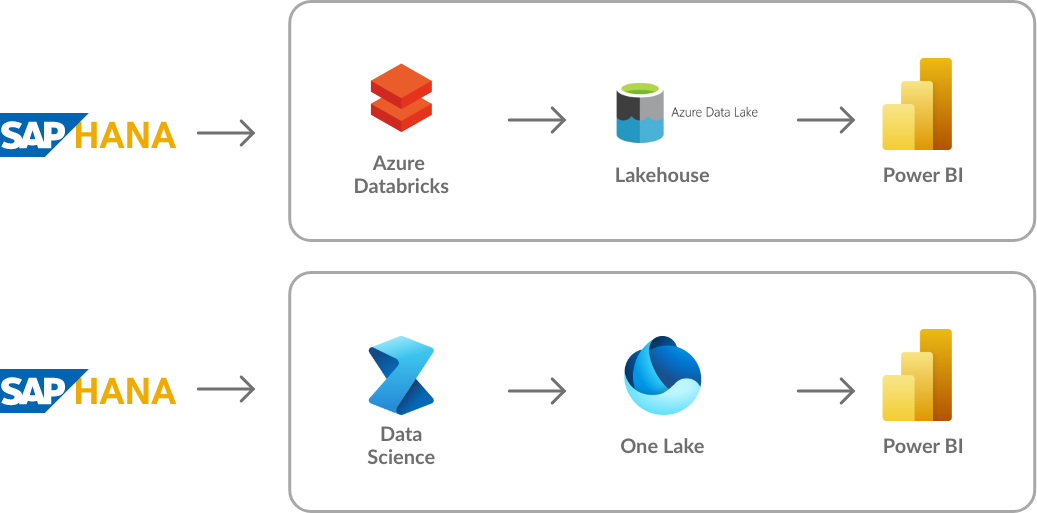
Once we gathered the requirements and domain knowledge, our team developed the AI-based forecasting tool in a preconfigured analytical environment, such as Databricks, using Python, PySpark, and SQL. We began with a small-scale implementation, focusing on high-priority or frequently sold products, allowing us to analyze and prepare data iteratively. Early-stage development involved simpler models, gradually advancing to more complex ones to ensure optimal performance and accuracy.
Forecast (with Power BI)
After achieving satisfactory results on a smaller scale, we expanded the solution to cover a larger scope, creating a fully automated AI-based forecasting tool tailored to the customer’s requirements. Throughout the process, we worked collaboratively with the customer to refine the tool and align it with their priorities.
The backend integrates with various data sources, transforms raw data into meaningful insights, and prepares it for Machine Learning (ML) algorithms. This includes an ML pipeline that trains models and reuses them to generate forecasts, with predictions stored in a database for seamless access.
On the frontend, we developed Power BI reports that connect to multiple data sources, including the ML predictions. These reports feature intuitive visualizations that compare human-made forecasts, AI-generated forecasts, and actual values. They also highlight products where AI predictions outperform manual forecasts. Beyond AI-driven insights, the reports provide additional information on demand trends and forecasts created by planners, enabling informed decision-making with greater accuracy and efficiency.
Summary
The project resulted in a tool combining an ML-powered backend with an intuitive Power BI frontend. Forecast creation time was reduced to just 10 minutes per product (on average), enabling demand planners to quickly adjust their forecasts based on AI-generated predictions. Over several months, this significantly improved overall forecast accuracy, leading to better demand forecasting.
We also provided a Power BI report that clearly presents forecast accuracy comparisons between human-created and AI-generated forecasts. This enables planners to identify areas where AI predictions significantly outperform manual forecasts (e.g., for specific products or groups). As a result, overall forecast accuracy improved by 20-30% through blending AI’s strengths with planners’ domain knowledge and handling factors not included in the ML models.
Additionally, the use of feature importance insights allowed planners to identify and monitor key factors influencing demand, further enhancing their ability to make informed decisions.
Key Data Architecture Components
Azure Databrics, Synapse, DataFactory, Lakehouse, PySpark, Power BI, Power App, SAP
Sounds interesting? Let’s talk!